 Use the Create Accessory button to create new FMS Accessory Node configurations. Accessory Nodes can be configured to support non-meter-specific components and activities in a facility such as compressors, battery banks, maintenance items, etc.
Note: This Node type is provided for users of the optional CygNet Dispatch product, and is applicable for scheduling non-meter-specific jobs in your system.
Use the Create Accessory button to create new FMS Accessory Node configurations. Accessory Nodes can be configured to support non-meter-specific components and activities in a facility such as compressors, battery banks, maintenance items, etc.
See Viewing and Editing Accessory Node Properties for more information about accessing properties for meters that have already been created.
To create a new Accessory Node, open the Nodes menu in FMS Explorer, and then click Create Accessory. A series of dialog boxes will appear.
Note: These dialog boxes are the same as dialog boxes that open when you View Node properties from many context menus in FMS Explorer and the FMS service in CygNet Explorer.
The following subsections list and describe property fields found on the Create Accessory dialog boxes.
To create a new Accessory Node, first define it in the system.
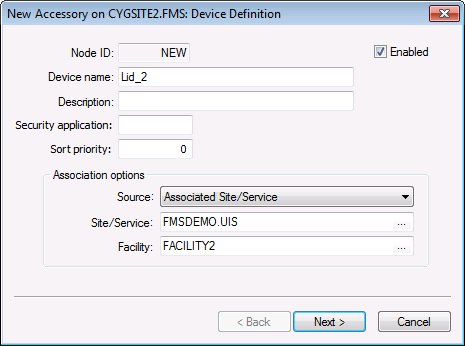
Enter the following properties to define the new accessory.
| Property | Description |
|---|---|
|
Node ID |
The system-assigned Node ID for the accessory. When creating new Accessory Nodes this will indicate NEW. |
|
Enabled |
The Enabled check box indicates whether the accessory is enabled or not. An unchecked box does not mean the Node is deleted; all Node settings are saved until you choose to enable the Node. Default value is Enabled. |
|
Device name |
Type in the name for the Accessory Node. Valid characters (maximum of 20) are as follows. A-Z, a-z, 0-9, . (period), #, $, &, (, ), +, -, \, /, :, <, >, =, @, [, ], ^, {, }, _ (underscore), !, ~ (tilde). Spaces are acceptable, when they are not leading or trailing. This parameter is required. |
|
Description |
Type in a free-form Description for the accessory. This parameter is optional. |
|
Security application |
Enter the security application used to validate users of the Node. Use this setting to control user access, for example, to only give certain users access to particular Accessory Nodes. See FMS Security for more information. This parameter is optional. |
|
Sort priority |
Type in the Sort priority number to assign to the Accessory Node. The priority number assigned places it within a manually sortable list. Higher numbers place a Node higher up on a list. Default value is 0. This parameter is optional. |
| Association options | |
|
Source |
Select the associated source from the drop-down menu to indicate how the selected accessory is associated with the system. Options are as follows.
|
|
Site/Service |
If the source is Associated Site/Service, click … to access the Select CVS dialog box and select the CVS associated with the accessory. |
|
Facility |
If the source is Associated Site/Service, click … to access the Select a Facility dialog box and select the facility for the Site/Service associated with the accessory. |
When you are done, click Next > to access the Device Properties dialog box.

When the Device Definition is complete, configure the Device Properties.
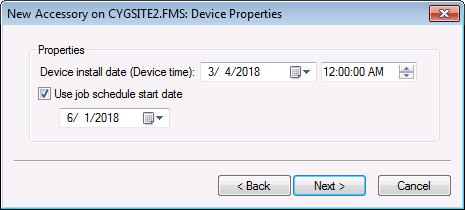
Enter the following properties to describe the new accessory.
| Property | Description |
|---|---|
| Properties | |
|
Device install date (Device time) |
Select the date and time of the installation of the accessory using the date and time selectors. When no user-entered value is provided, the default install date value is 36 days prior to Node creation, at 12:00:00 AM. |
|
Use job schedule start date |
Note: This parameter defines a date used by the Schedule Jobs command for CygNet Dispatch. For more information about the CygNet Dispatch product, contact your Account Manager or CygNet Sales. When using CygNet Dispatch, optionally set this value to define the first possible start date that can be used for job occurrences associated with this Node, when automatically scheduling jobs via the Schedule Jobs command. If used, click the check box to access the date selector, and specify the earliest date from which CygNet Dispatch jobs for this Node can be scheduled. When no user-entered value is provided, the default value is the Device install date. See Schedule Jobs for more information. |
When you are done, click Next > to access the Time dialog box.
When the Device Properties are complete, configure the Time properties.
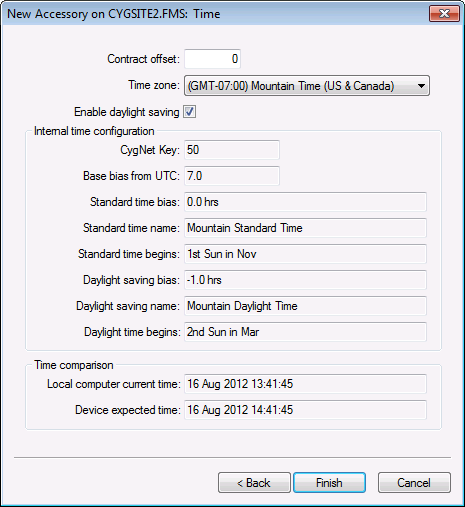
Enter or verify the following time fields for the new Accessory Node.
| Property | Description |
|---|---|
|
Contract offset |
Type the number (in hours) of the contract hour offset. This number is synonymous with the Contract time. It is an offset (in hours) from the Device time, describing the hour at which the contract day begins. |
|
Time zone |
Click to select the desired time zone from the drop-down menu. Note: Edits to this property can only be applied for the entire span of the Node. An error message will appear if you try to edit this value for a partial span. |
|
Enable daylight saving |
Click to enable an adjustment for daylight saving time. Notes:
|
| Internal time configuration | |
|
CygNet Key |
An internal CygNet identifier Each time zone is assigned a unique numerical key in the CygNetTimeZones.xml file, located in the CygNet\Services\ARS folder on your host server. This property is read-only. Note: This value requires a properly installed CygNetTimeZones.xml file. See CygNetTimeZones.xml File for more information. |
|
Base bias from UTC |
The offset in hours between the device's expected time and Coordinated Universal Time (UTC) (also known as Greenwich Mean Time or GMT) This property is read-only. |
|
Standard time bias |
The offset in hours from the base bias to account for standard time in the selected time zone This property is read-only. |
|
Standard time name |
The complete standard time zone name, for example Eastern Standard Time This property is read-only. |
|
Standard time begins |
The date that standard time begins, for example 1st Sun in Nov. This property is read-only. |
|
Daylight saving bias |
The offset in hours between standard time and daylight saving time This property is read-only. |
|
Daylight saving name |
The complete daylight saving time zone name. For example, Pacific Daylight Time This property is read-only. |
|
Daylight time begins |
The date that daylight saving time begins, for example 2nd Sunday in March This property is read-only. |
| Time comparison | |
|
Local computer current time |
The time of the client computer Do not alter the client computer's time; it may cause undesirable changes in your CygNet system. This property is read-only. |
|
Device expected time |
The time expected for the remote device This property is read-only. |
When you are done, click Finish to access the Save FMS Record dialog box.
Once the new Accessory Node properties are configured, you'll be asked to save your changes via the Save FMS Record dialog box. Configure the date and audit information requested to historize the changes in your system.
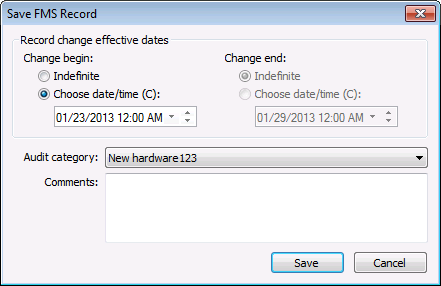
Specify the following parameters to describe the saved record.
| Property | Description |
|---|---|
|
Change begin |
Set the effective date and time for the record change to begin. Options are as follows.
|
|
Change end |
Note: Upon Node creation, this date selection is automatically set to Indefinite. Options become available for edits made to Node properties. |
|
Audit category |
Select an appropriate Audit category from the drop-down menu. The audit category type for Node creation is Configuration Change. Audit categories are configured on the Admin menu. See Configuring Audit Categories for more information. |
|
Comments |
Type Comments regarding creation of the Node in the text box. Although comments are optional, they become part of the record and can be helpful when auditing or reviewing records. |
When all parameters are configured, click Save to save the new Accessory Node settings.
|
|
|

